
Home / Power Supplies /
Transistorized Voltage Regulator
Why use a transistorized voltage regulator? If we use a half or a full-wave rectifier, we can convert an AC voltage in a DC one. This converted voltage is unregulated because the output voltage is not constant and can change due to variations of the load value.
To reduce these variations, we connect a regulator circuit in series with the unregulated output. These circuits reduce the ripple voltage from the output of unregulated sources, and the final voltage varies very little with load variation.
Zener diode and transistor voltage regulator
This circuit delivers on its output a voltage set by the zener diode voltage minus 0.7 volts. The 0.7 volts is the base-emitter voltage drop (VBE) on the transistor: Vout = Vz – Vbe = Vz – 0.7V.
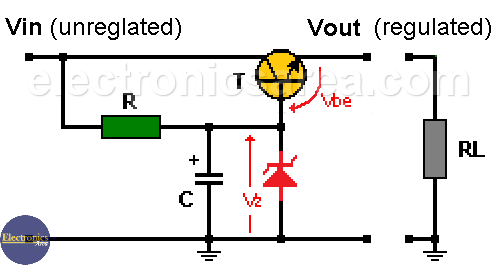
Transistorized Voltage Regulator (Zener & Transistor)
The voltage in the Zener diode does not vary much with the change of the current passing through it, so the output voltage of the regulator will vary slightly with the variation of the load (RL).
In this type of voltage regulator, the Zener diode sets the reference voltage, and the transistor functions as a pass-through current amplifier for the load.


