
The Thevenin’s theorem
The Thevenin’s theorem is used to convert a two terminal complex circuit, into a very simple circuit containing only one voltage source (Vth) in series with a single resistor (RTH). See pictures #1 and #5.
- Vth is called the Thevenin voltage
- Rth is called the Thevenin resistance and all together is called the Thevenin equivalent circuit
The new circuit will have a voltage source in series with a resistor (the Thevenin equivalent circuit), in series with the resistor (see the 5K resistor on the right side of picture # 5).

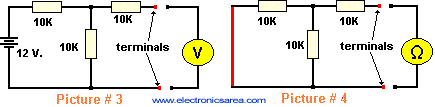
To obtain the Thevenin Voltage, we get the voltage at the two terminals as showned on picture # 3. This voltage is called The Thevenin voltage
To obtain the Thevenin Resistance (RTH) all voltage sources are replaced by short circuits. Then we measure the resistor at the two same terminals (picture # 4)
With these two data we can set up a new and very easy to understand circuit, which is called The Thevenin equivalent Circuit. With the Thevenin equivalent Circuit is very easy to get the voltage, the current and the power on the 5k resistor (picture # 5)
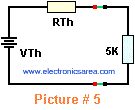
In this case Vth = 6V and RTH = 15 K
Thus, on the 5K resistor:
- I (current) = V/R = 6/20K = 0.3 mA (milliamps)
- V (voltage) = IxR = 0.3 mA x 5K = 1.5V (volts)
- P (power) = PxI = 0,675 mW (miliwatts)


