Home / Semiconductors /
The Semiconductor Diode
The semiconductor diode is the simplest semiconductor component and can be found in virtually any electronic circuit. Diodes are manufactured in silicon (the most widely used) and germanium versions.
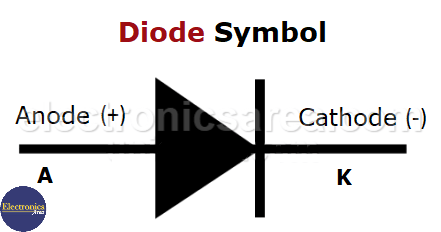
Symbol of the diode, in the image you can see: A (anode) and K (cathode).
A p-n junction diode is made of a semiconductor crystal, usually silicon, and, to a lesser extent, germanium.
Two regions are created:
- N-type region: impurities are added to create a region with negative charge carriers, called an n-type semiconductor.
- P-type region: impurities are added to create a region with positive charge carriers, called a p-type semiconductor.
These two regions are separated by a junction called the p-n junction. This p-n junction is about 0.3 to 0.35 volts for the germanium diode and 0.6 to 0.7 volts for the silicon diode.
Diode principle of operation
The N-type material has free electrons (excess electrons), and the P-type material has free holes (absence or lack of electrons).
- When a positive voltage is applied to the P-type side and a negative voltage to the N-type side, the electrons on the N-type side are pushed to the P-type side and the electrons flow through the P material beyond the boundaries of the semiconductor. Similarly, the holes in the P material are pushed with a negative voltage to the side of the material N and the holes flow through the N material.
- When a positive voltage is applied to the N side and a negative one to the P side, the electrons on the N side are pushed to the N side and the holes on the P side are pushed to the P side. In this case the electrons in the semiconductor do not move, and consequently there is no current.
The semiconductor diode can work in 2 different ways:
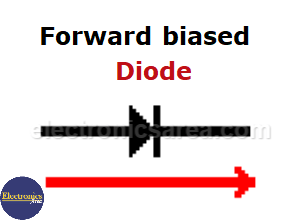
Forward biased
This happens when the current flowing through the diode follows the path of the arrow, that is, from the anode to the cathode. In this case, the current passes through the diode very easily, behaving practically like a short circuit.
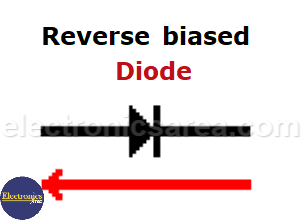
Reverse biased
This happens when the current in the diode wants to flow in the opposite direction to the arrow, that is, from the cathode to the anode. In this case, the current does not pass through the diode, and it behaves practically like an open circuit.
Note: The aforementioned operation refers to the ideal diode; this means that the diode is taken as a perfect component (as is done in almost all cases), both in forward bias and in reverse bias.
Real diode Current-Voltage Relationship
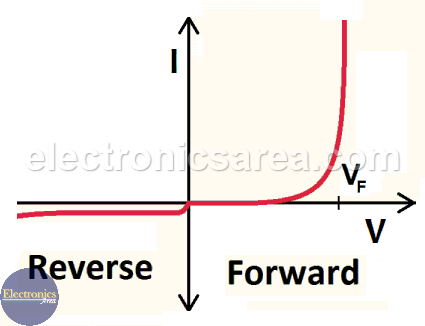
VF is 0.3 volts in the germanium diode and approximately 0.6 volts in the silicon diode.
Note: The operation mentioned before refers to the ideal diode, meaning that we take the diode like a perfect component.
Semiconductor diode applications
Diodes have many applications, but the most common one is the process of conversion from alternating current (A.C.) to continuous current (C.C.). In this case, the diode is used like a rectifier diode.
Other diode applications:
- Reverse voltage protection
- Flyback diode in inductive loads
- etc.