
What is resistivity?
Electrical resistivity [ρ] (rho) is a characteristic of materials and has an ohm-meter unit. Resistivity indicates how much the material opposes the flow of electric current.
The resistivity formula
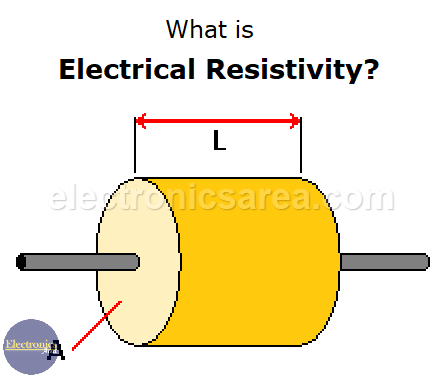
The resistivity [ρ] (rho) has the formula ρ = R*A/L. Where:
- A is the cross-sectional area (m2).
- ρ is the resistivity (ohms-meter).
- L is the length of the material (meters).
- R is the value of the electrical resistance (ohms).
From the previous formula, it is deduced that the resistance depends on:
- Its construction
- The resistivity (material with which it was manufactured)
- Its length
- The cross-sectional area.
Clearing “R” from the previous formula, we obtain R = ρ*L/A.
If we analyze the formula, it follows that:
- The greater the length and the smaller the cross-sectional area of the element, the greater the resistance.
- The smaller the length and the greater the cross-sectional area of the element, the lower the resistance.
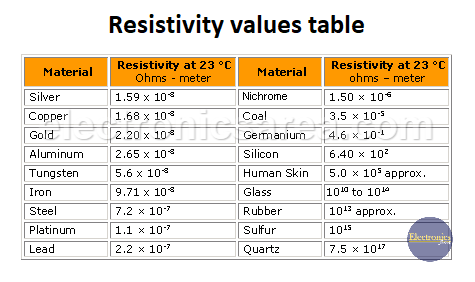
Typical values of resistivity of various materials:
The following table shows typical values of various materials at 23°C:
Resistivity depends on temperature
Resistivity does not remain constant with the variation of the temperature. Resistivity of metals increases if the temperature increases, unlike semiconductors, where this value decreases.

What is conductivity?
Conductivity, or electrical conductivity, is a measure of a material’s ability to conduct an electric current. Conductivity (σ) [sigma] is the inverse of resistivity, and its formula is σ = 1/ρ = 1/(R*A/L) = L/(R*A).
Example 1
The resistance of 25 meters of copper wire with 3 mm2 of cross-sectional area can be calculated as
(Copper wire has a ρ = 1.7 x 10⁻⁸ Ω m.).
R = ρ * L / A = (1.7 x 10⁻⁸ Ω m) (25 m) / ((3.00 mm2)(10⁻⁶ m/mm)) = 0.1417 Ω.
Note: 1 mm2 = 1 x 10⁻⁶ m.
Example 2
The copper wire above is reduced to a 0.50 mm2 cross-sectional area. The increase in resistance can be calculated to:
R = ρ * L / A = (1.7 x 10⁻⁸ Ω m) (25 m) / ((0.50 mm2)(10⁻⁶ m2/mm2)) = 0.85 Ω.
Note: 1 mm2 = 1 x 10⁻⁶ m2.
More resistor tutorials
- Resistors in Series – The Equivalent Resistance
- Resistors in parallel (Equivalent resistor value)
- Resistors in parallel (Equivalent resistor value)
- Series/Parallel Resistor Reduction
- What is Electrical Resistivity?
- Resistor Tolerance. What is it? – Color code
- Temperature effect on resistance
- What is Electrical Resistance? Obtaining a material’s resistance
- Wirewound Resistor
- LDR – Photoresistor


