
What is a relay?
Relay was invented in 1835 by the US scientist Joseph Henry (1797–1878). Relay or elecromagnetic switch is a magnetically operated switch that is activated or deactivated when the electromagnet is energized. The electromagnet is energized when a voltage is applied to the relay input terminals.
This operation causes connection or disconnection between two or more output terminals. This connection is achieved with the attraction or repulsion of a small arm called armature. This small arm connects or disconnects the output terminals.
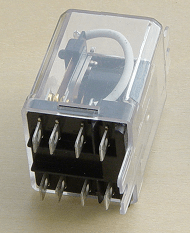
General purpose relay, 60 hz 110 volt coil, DPDT contacts 25A at 300V AC
Leonard G. at English Wikipedia [CC SA 1.0], via Wikimedia Commons
How does a relay work?
- If an electric current passes through the coil, it pulls the armature and connects points C and D.
- If no electric current passes through the coil, the connection is made on points D and E.
This way we can connect one device when the coil is active and another one when it is not active.
There are relays with two output contacts terminals like the one in the diagram, but there are also relays with 4 output terminals or more. This allows the same relay to activate or deactivate more devices.
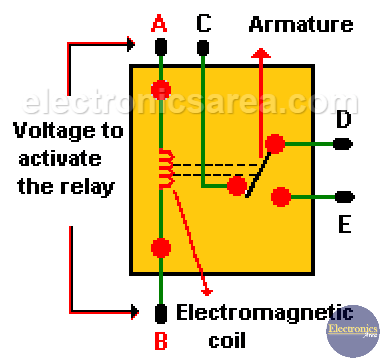
Relay (magnetically operated switch) – Relay switch diagram
Types of Relay
- Solid State Relays (SSR). These relays use thyristors and triacs for their operation. The coupling, between the input circuit and the output circuit, is optical. SSR are faster, quieter, smaller, more reliable, and last longer than electromagnetic relays.
- Industrial relays. These relays handle high currents and are long lasting.
- Interlocking relays. Devices that are activated or deactivated with a voltage pulse. Depending on the polarity of the pulse, the position of the contacts change.
- Thermal relays. They are used to protect motors against over-temperature. When the temperature reaches a certain level, it is activated and disconnects the contactor which in turn disables the motor.
- Reed relays. This device is very basic and has a small size. It is a fast operating switch design with only one NO contact. Some have glass encapsulation and others with metal encapsulation to prevent external magnetic fields from activating the relay.
- Mercury relays. Inside it has a drop of mercury that moistens the contacts, giving them a longer life and avoiding the rebounds that appear when they are activated.
- Contactors. These devices have the same principle of operation of relay. The current, voltage or power values are very large and the contactors must have characteristics that withstand these values.
Advantages
- It allows to control a remote device. It is not necessary to be near the device to make it work.
- Change contacts easily.
- Isolates the activating part of the actuating part.
- It works well at high temperatures.
- It is activated with low current, however it can activate large machines of great power.
- With a single signal you can control several contacts at once.
- It can switch direct current or alternating current.
Disadvantages
- Contacts are damaged over time and continuous use (wear, oxidation, etc.)
- They generate a lot of noise with the activation and deactivation of the contacts.
- Switching time is high.


