
Home / Transformers /
The power transformer usage
The electric transformer distribution system. Electric power transformers are static electrical machines that allow modification of the voltage and the current values, so they can take the appropriate one (value) to carry and distribute the electric energy.
The reason of the power transformer usage is that it is cheaper when the electric current is carrying out at high voltages. You have to remember that for one amount of power, the higher the voltage, the lower the current on the conductor.
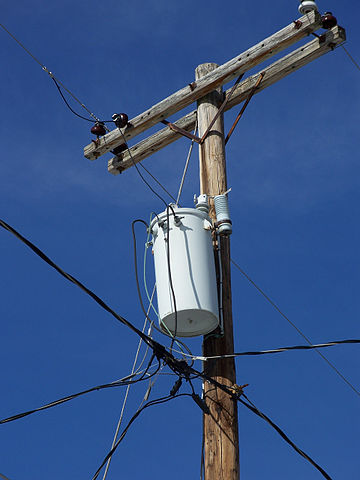
By DMGualtieri – Own work, CC0, Link
Then the less the cross-section of the conductor that is needed. A conductor that has a small cross-section is cheaper.
The cross-section area of the conductor that is needed on a transmission line is inversely proportional to the square of the voltage value that has been assigned to the electricity transportation. This explains the convenience of the use of high voltages in the transportation of the electric energy.
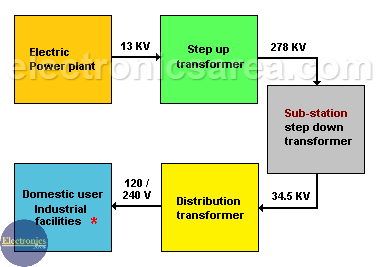
In the same way power transformers are used to raise the voltage and allow the current transportation over long distances, transformers are also used to reduce the voltage to an acceptable level for domestic and industrial usage.
The picture above shows the general procedure of energy distribution from its generation to the final delivery for domestic and industrial usage.
Note:
- Many industrial facilities (*) do not have its connection to a 120 / 240 supply voltage but to a 34.5 KV.
- 1 KV = 1000 V. For example 34.5 KV = 34500 volts.
- Voltages shown on the picture above may vary from one country to another.
More Transformer Tutorials
- Ideal Transformer Working Principle
- Transformer Turn Ratio (K)
- Impedance matching Transformer
- Autotransformer
- Transformer Structure
- Power Transformer usage
- Equivalent transformer circuits (power, audio, video and RF)
- Why is the core of a transformer laminated?


