
Electronics Area
Tutorials Community Calendar Diagrams Articles Downloads Links
Register
Username:
Password:
Save Password Forgot your password?
Menu
- Active topics (0)
- New Articles (0)
- New Downloads (0)
- Private messages
- My Bookmarks
- Site Statistics
- PM Pager
- Useful links

Members: 39
Active Users:
0 Members and 10 Guests

Last 5 Articles
How To Increase A Slow PC Without Configure Your PC
Slow computers are a vast problem for millions of people throughout the World, causing many people t...

The Basics of Electrostatics
The branch of science known as electrostatics is a complicated one. This isn't because it is extreme...

The Development of The First Microphones
The invention of the microphone was a result of the development of the telephone. As a technology wa...

Internet Calls: a New Way to Connect
Long distance calls can be made at almost free call rates with the introduction of internet calling ...

Future of Electricity
We are all tired of looking at cables spread through our house like snakes, trying to hide them unde...


Electric Field
Electric Field

1 The electrostatic Force
2 Coulomb's Law
3 Positive and Negatives charges
4 Electric field. Electric Field lines of Force
5 The electric field Unit
6 Polarization of a conducting material
7 Polarization of a dielectric material
The Hunger Site

The Rainforest Site
This article is part of the following tutorial >>

Atoms consist of protons, electrons and neutrons.

They join each other to form structures of different substances according to the existing physical conditions, such as: temperature

If a metallic body in a vacuum is not subject to the influence of an electric field, its positive and negative charges are evenly distributed and it is concluded that the body is neutral. Look at picture # 1

If you then consider that there is an electric field E near the metal, the metal negative charges (electrons) move under the influence of the field E.

As a result the charge distribution within the metallic body changes, part of the metal is positively charged and the other part becomes negatively charged.
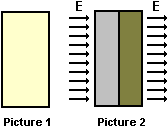
However, taking the metallic body as a whole, it remains neutral, as the number of charges has not changed. Look at picture # 2

The charges try to distribute itself on the surface of the metal, as a result, we have an electrically charged body that attracts and repels other bodies.

Under these conditions it is said that the metal is polarized.

If the electric field is removed, the metallic body returns to its previous state.

What this means is that the electric field has the ability to alter the distribution of electrical charges inside a body. Look at picture # 1

Polarization of a conducting material - Electronics Area

Take note that this concept applies to a conductive body.

The non-conducting bodies, called insulators or dielectric, can also be polarized, but this polarization occurs at the level of molecules or groups of molecules.

Sponsors


Set as your default homepage Add favorite Privacy   © 2008-9 ElectronicsArea.com All Rights Reserved MaxWebPortal Snitz Forums Go To Top Of Page