
Home / Semiconductors /
What is a Phototransistor?
A phototransistor is essentially the same as a common transistor, but it can work in two different ways:
- As a common transistor, using the base current (IB)
- As a phototransistor, using the light that illuminates this element and that acts as the base current. (IP).
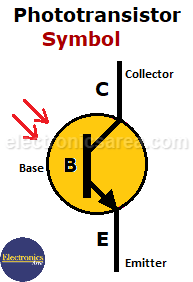
Phototransistor Symbol
Spectral Response
The output of a phototransistor depends upon the wavelength of incident light. These devices respond to light over a broad range of wavelengths from the near UV (ultraviolet), through the visible and into the near IR (infrared) part of the spectrum. Unless optical filters are used, the peak spectral response is in the near IR.
How the Phototransistor works?
You can use both simultaneously, although it is mainly used with the base terminal that is not connected (IB = 0). The total base current is equal to the base current (as a common transistor) + base current (using the light as a base current / photocurrent): IBT = IB + IP.
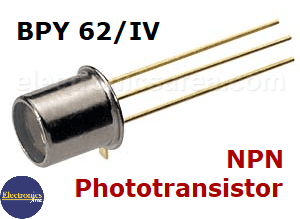
If you want to raise the sensitivity of the device, due to low lighting that brightens the phototransistor, we can increase the base current (IB), using an external bias.
Equivalent circuit
Phototransistor = photodiode + Transistor
A phototransistor is a common transistor with a photodiode connected between the transistor’s base and collector, like on the image above. The cathode must be connected to the collector and the anode to the base of the transistor. It is widely used on light detection applications.
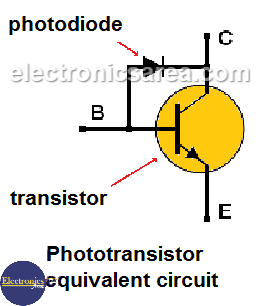
This device as the photodiode, has a short time response. But it can handle much higher current. The picture show the equivalent circuit.
You can see that the current goes from the photodiode to the base of the transistor, and from the base to the transistor’s emitter. The phototransistor’s emitter current can be ß times the photodiode current.
Note: ß is the current gain of the transistor.


