Electronics Area
Tutorials Community Calendar Diagrams Articles Downloads Links
Register
Username:
Password:
Save Password Forgot your password?
Menu
- Active topics (0)
- New Articles (0)
- New Downloads (0)
- Private messages
- My Bookmarks
- Site Statistics
- PM Pager
- Useful links

Members: 39
Active Users:
0 Members and 7 Guests

Last 5 Articles
How To Increase A Slow PC Without Configure Your PC
Slow computers are a vast problem for millions of people throughout the World, causing many people t...

The Basics of Electrostatics
The branch of science known as electrostatics is a complicated one. This isn't because it is extreme...

The Development of The First Microphones
The invention of the microphone was a result of the development of the telephone. As a technology wa...

Internet Calls: a New Way to Connect
Long distance calls can be made at almost free call rates with the introduction of internet calling ...

Future of Electricity
We are all tired of looking at cables spread through our house like snakes, trying to hide them unde...


Oscillators
This article is part of the following tutorial >>

Oscillator circuits with operational amplifiers and a RC network

This section discusses some practical oscillators that use operational amplifiers and RC networks.

The Wien bridge oscillator

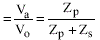
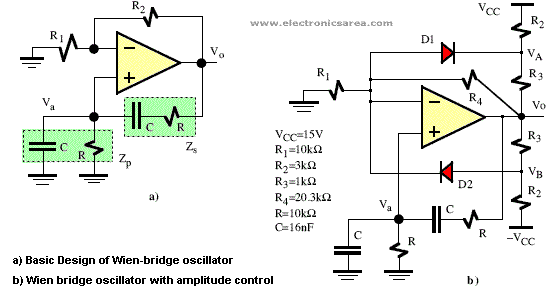
The Wien-bridge oscillator, as shown in the basic outline of the picture, consists of an Operational Amplifier (OA) in a non-inverting configuration with gain 1 + R2/R1 and a RC feedback network with transfer function:

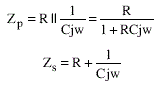
Transfer function of a Wien-bridge oscillator - Electronics Area

Where

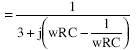
Combining the first and the second equation we get:

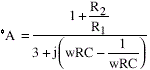
The loop gain (BA) is:

a) Basic design of a Wien-bridge oscillator.  b) Wien bridge oscillator with amplitude control - Electronics Area

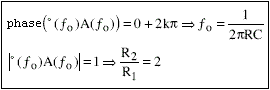
The Barkhausen criterion defines the conditions for oscillation at frequency ƒo:
The Barkhausen criterion defines the conditions for oscillation at frequency ƒo - Electronics Area

To ensure the conditions of oscillation, R2/R1 must be chosen slightly higher than 2 to correct small variations in the circuit. Furthermore, the amplitude of oscillation can be determined and stabilized using a nonlinear circuit as shown in picture above. The diodes D1 and D2 and resistors R2 and R3 act as limiting the output amplitude.

Sponsors


Set as your default homepage Add favorite Privacy   © 2008-9 ElectronicsArea.com All Rights Reserved MaxWebPortal Snitz Forums Go To Top Of Page