Home / Semiconductors /
LED – Light-emitting diode
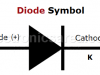
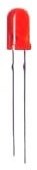
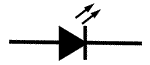
Light-emitting diode (LED) is a special type of diode, that emits light when it is forward biased. There are LEDs of various colors. LED colors depend on the material with which they were built. There are red, green, yellow, amber, infrared, etc.
If a current flows through a semiconductor diode, there are electrons and holes injected in the P and N regions, respectively. The bigger the current on the LED, the bigger is the recombination of electrons and holes.
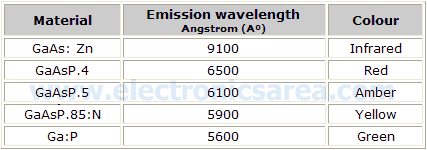
There is one kind of recombination called, radiant recombination (here the emission of light). The relationship between the radiant recombination and the total recombination, depends on the semiconductor material used (GaAs, GaAsP and GaP). The wavelength and the light color depend on the material the LED was made of.
You must choose the right current that is going to pass through the LED, to get a good light intensity and prevent any damage to it. LEDs has an operating voltage ranging from 1.5 V to 2.2 volts, and the range of currents that must flow through it is between 10 and 20 milliamps (mA) in the red diodes and between 20 and 40 milliamps (mA) for the other LEDs.
The Light Emitting diode has huge advantages over common indicator lamps:
- Low power consumption
- Virtually no maintenance,
- Lifetime of approximately, 100000 hours, etc.
One disadvantage for the common LED is its low lighting power. Its light is invisible under a bright light source, and its angle of visibility is between 30° and 60°. This problem is solved using light diffusers. Also, new ultra high-efficiency LEDs are used in lighting fixtures and in everyday uses around the home and everywhere.
LEDs must be protected. A small amount of current on the opposite direction doesn’t damage it, but if there are unexpected peaks of current, it can be damaged. One way to protect them is to place a common silicon diode in parallel with the LED, pointing in the opposite direction.
LED Applications
LED is widely used in visual applications, indicating some specific situation of operation. LEDs are also used as part of an optocoupler in a wide variety of applications