
Oct 162019
Home / Semiconductors /
The Field Effect Transistor (FET)
Field effect transistor or FET is a exciting transistor and it can be of two types: the Junction Field Effect Transistor or JFET and the Metal-Oxide Semiconductor Field Effect Transistor (MOSFET). These devices have a high input impedance (1012 ohms) and they are controlled by voltage.
Both devices are used as an amplifier or a switch in analog and digital circuits.
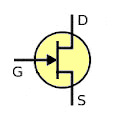
Electrical characteristics of JFET and MOSFET are similar although their technology and physical structure are totally different.
Advantages of FETs
- They are devices controlled by voltage with a very high input impedance (107 to 1012 ohms)
- FETs generate a lower noise level than the Bipolar Junction Transistor (BJT)
- FETs are more stable than BJT with temperature
- FETs are easier to manufacture than the BJT, because they require fewer steps to be built and they allow more integrated devices in the same IC
- FETs behave like resistors controlled by voltage for small drain-source voltage values
- The high input impedance of FET allows them to withhold loads long enough to allow its usage as storage elements
- Power FETs can disipate higher power and can switch very large currents
Disadvantages of FETs
- FETs have a poor frequency response due to its high input capacitance
- FETs have a very poor linearity, and generally they are less linear than Bipolar Juntion Transistor
- FETs can be damaged due to the static electricity