
What is Joule’s Law? The Joule effect
It is known as the Joule effect, the phenomenon by which if an electrical current circulates in a wire, part of the energy is transformed into heat. Joule’s Law is named after the British physicist James Prescott Joule.
Joule’s law shows the relationship that exists among
- The current that flows through a wire.
- The heat generated by the current that flows through a wire.
- The resistance of the wire and …
- The time the current passes through the wire.
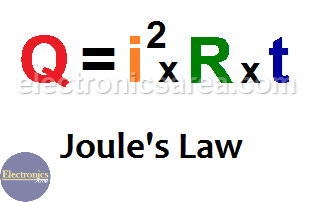
The Joule’s Law formula (amount of heat)
Joule’s law formula is Q = I2 · R · t, where:
- jQ is the amount of heat, in Joules (J)
- I is the electric current that flows through the wire, in amperes (A)
- R is the value of the electrical resistance of the wire, in ohms (R)
- t is the amount of time that current passes through the wire, in seconds (s).
Joule’s law can be established as the amount of heat (Q) generated in a wire with resistance (R) when a current (I) passes through it for a period of time (t).
This heat is directly proportional to the following:
- The square of the current.
- The resistance of wire.
- The time the current flows through the wire.
What are the heating effects caused by electric current?
When a current flows in a wire, thermal energy is generated in it. The heating effects caused by electric current depend on three factors:
- The resistance of the wire. Higher resistance produces more heat.
- The time that current flows through the wire. The greater the time, the greater the heat generated.
- The greater the current, the more heat generation.
Some applications of Joule’s law
- Water heater.
- The incandescent bulb (it also generates light).
- Fuse (the fuse melts and burns when the current exceeds a set limit).
- Electric iron.
- Electric stove.
- Thermistors: Thermistors are resistors whose resistance changes when the temperature changes.
- etc.
Examples
Example 1: How much heat does a 2 amp current generate in a wire with a 50 ohm resistor for 2 seconds?
We have: I = 2 amps, R = 5 ohms, t = 2 seconds.
Using the formula J = I2 · R · t, we get J = (2)2 x (5) x (2) = (4) (5) (2) = 40 joules. Then: 40 Joules of heat are produced.
Example 2: The resistance of an electric bulb is 100 ohms. When 120V is applied across its ends, find the power consumed in 1 hour.
We have. R = 100 ohms, V = 120 volts, t = 1 hour = 3600 s.
Using Ohm’s Law formula, I = V/R, I = 120/100 = 1.2 amps.
Using the formula J = I2 . R . t, we get J = (1.2)2 x (100) x (3600) = (1.44) (100) (3600) = 518 400 joules. Then the power consumed in 1 hour is 518400 Joules = 0.144 kWh.
Notes:
- 1 joule = 0.24 calories of thermal energy
- 1 Kilowatt-hour = 1 KWh = 1 000 watt x 3 600 seconds = 3.6 x 10⁶ joules (1 KWh = 3 600 000 joules)