
The Electrical Resistance
The electrical resistance is a measurement of the opposition that offers a material to the passage of electrons (the electric current). When a material, such as metals, has many free electrons, it allows the easy flow of electrons and it is called conductor. For example: copper, aluminum, silver, gold, etc..
If the material has few free electrons instead, it will oppose to the flow of electrons and this is called dielectric or insulator. For example: ceramic, Bakelite, wood (paper), plastic, etc. The main factors that determine the resistance of a material are:
- Type of material
- Length
- Cross-section
- Temperature
A material can be an insulator material or a conductor material, depending on their atomic configuration. It also may be a better or worse conductor or a better o worse insulator, depending on their atomic configuration.
Features of the Electrical Resistance
A larger material has less electrical resistance. See additional information: The resistivity.
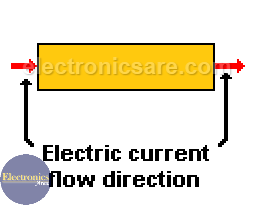
A longer material offers more electrical resistance to the flow of the electric current than a material of shorter length.
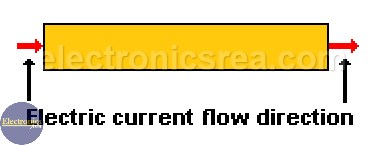
The material with thick cross-section offers bigger resistance to the electric current than a material with a wide cross-section.

A material with greater cross-section has less resistance. The direction of the electric current in the pictures gets in or gets out from the screen.

The materials that are on high temperatures have bigger electrical resistance. See: Variation of the electrical resistance with temperature.
The unit of measurement of the electrical resistance is the Ohm, and it is represented by the Greek letter omega (Ω) and it is expressed with the letter “R”.
The electrical resistance is a function of both its physical geometry and the resistivity of the material it is made from. R = L · ρ/A, where:
- L: is the length (meters)
- ρ: is the resistivity of the material (ohms·m), and
- A: is the cross-sectional area (m2)
More resistor tutorials
- Resistors in Series – The Equivalent Resistance
- Resistors in parallel (Equivalent resistor value)
- Resistors in parallel (Equivalent resistor value)
- Series/Parallel Resistor Reduction
- What is Electrical Resistivity?
- Resistor Tolerance. What is it? – Color code
- Temperature effect on resistance
- What is Electrical Resistance? Obtaining a material’s resistance
- Wirewound Resistor
- LDR – Photoresistor


