
The Electric Field Definition
An electric field is created when a charge Q is affected by an electrostatic force. The following formula illustrates this relationship.

From the formula, we can see that the unit is Newton/coulomb (in the MKS system). Newtons are a unit of force, and coulombs are a unit of electric charge.
Notes:
- One coulomb is the electric charge carried by 6.28 x 10¹⁸ electrons. (1 Coulomb = electric charge of 6.28 x 10¹⁸ electrons.)
- One ampere is one coulomb per second. (1 Ampere = 1 coulomb / second.)
Given the electric field at a particular point, we can determine the electrostatic force on a charge Q at that point. The following can be obtained by solving the above formula:

Electric Field lines of Force
An electric field can be represented by lines of force, which do not actually exist. These lines are useful for understanding how the field works. See the diagram below.
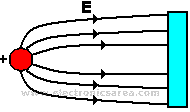
Electric Field lines of force
The lines of force indicate the direction of the electric field (E) at each point. These lines never intersect, and when they are close together, it indicates a stronger field.
However, we must consider that the number of lines of force is the same for a given electric field. These lines always begin at a positive charge and end at a negative charge. See the picture above.
The Electric Field Unit
The electric field unit can be easily deduced from the following formula: E = F/Q.
The electric field is the ratio of an electrostatic force (F) to an electric charge (Q), and it is measured in Newtons per Coulomb. We can use other values to help clarify the concept of the electric field.
An F force will be applied to a charge placed in an electric field (E). If this charge is then moved in the opposite direction of the force from point A to point B, an amount of work (W) will be done. This work is defined as follows:
W = F × d = Q × E × d.
F = Q x E (clearing F from the formula at the top). From the last formula, we obtain W/Q = E x d.
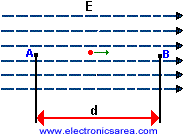
The E x d expression is called the potential difference between points A and B and is represented as VAB. Therefore, VAB = E × d.
Solving the last equation for the electric field (E), we obtain E = VAB/d, where the unit is volts per meter. (volts/meter.)


