
Electric Current Definition
The electric current is a current of electrons that crosses a material. Some conductive materials have free electrons that easily pass from an atom to another. These free electrons, if they move in the same direction as they jump from one atom to another one, become an electric current.
To achieve this movement of electrons, it is necessary a external power source. When a electricaly neutral material is placed between two bodies with different potential, electrons will move from the body with more negative potential to the body with more positive potential. Look at the picture
The electrons travel from the negative potential to the positive potential. However by Franklin’s naming convention, the sense of the electric current goes from the positive potential to the negative potential. (This was made around 1750, now is to late to be changed)
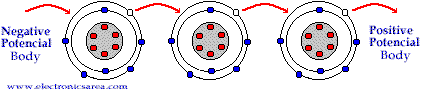
You can visualize it as a hole that is left behind by the electron when moving from a negative potential to a positive one. This hole is positive (absence of an electron) and circulates in the opposite direction of the flow of the electrons.
This current is measured in Amperes (A) and it is represented by the capital letter I.
So far we have assumed that the electric current is going from one terminal to another continuously. This electric current flow is called continuous current. There is another case in which the electric current circulates in an alternated form, first in one direction and then in the opposite one. This type of current is called alternating current.


