
DC Theory Tutorials
Home /
Direct Current (DC) Theory Tutorials
Energy and Electric Power. Performance
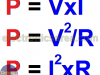
Power is the speed at which work is done. Electric power is the multiplication of the current (amps) by the voltage (volts). P = I x V.
Voltage Divider – Voltage Divider Formula
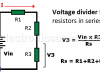
The voltage divider is a circuit that allows us to obtain an output voltage less than the input voltage. The output voltage is normally obtained across ground and the resistor connected to it, but it could be across any of the other resistors.
Ohm’s Law and Electric Power – Formulas
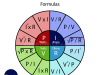
Ohm’s law and electrical power. Ohm’s law relates V, I, and R. A more complete expression of Ohm’s law is achieved using the electrical power formula
Current Divider Rule in parallel resistors
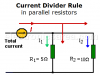
By using the current divider rule, we can find the current in each resistor connected in parallel. The electric current passing through a circuit of two resistors in parallel is divided in two.
DC Motor – Parts of a DC Motor. Basic Operation Principle.
DC Motor
A DC motor is composed of a stator and a rotor. In many small motors, the stator is composed of magnets. Larger motors have windings.
Mesh Current Method – Steps to follow – Example
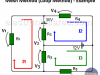
The mesh current method is very useful for finding all the currents in a network. This method, a little more advanced, is also applied to circuits where there are resistances and reactances.
Node Analysis Method – Steps – Example
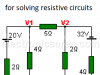
The node analysis method also known as the nodal analysis is widely used to solve linear resistive circuits (this method, in a slightly extended form, also applies to resistive-reactive circuits)
Maximum Power Transfer Theorem Explanation
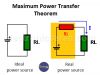
What does the Maximum Power Transfer Theorem say? “The maximum power transfer to the load is obtained when the load resistance RL is equal to the internal resistance of the…
Step Response of RL Circuits
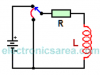
When a constant voltage is suddenly applied to an RL circuit, an increasing a current goes through the conductor and creates a magnetic field that expands with the increasing current
What is Direct Current? – What is DC?
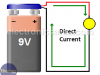
Direct Current (DC), is the result of the flow of electrons (negative charge) in a conductor (most of the time, wires of copper) that goes only in one direction.
Benjamin Franklin’s Fluid Theory

Benjamin Franklin imagined the electricity as a invisible fluid. Franklin assured that if any body had more fluid than usual, it could have a positive charge, but if it had less fluid than normal it had negative charge.
Voltage – Electrical Potential Difference
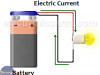
Potential difference or Voltage is a kind of force that push charges through a conductor. The larger the voltage, the larger the force
Millman’s Theorem – Millman’s equivalent circuit
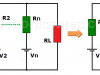
Millman’s theorem is used to directly obtain the voltage between the ends of a parallel branch circuit. Equivalent Millman circuit Formulas, example.
Norton’s Theorem
Norton’s Theorem The Norton’s Theorem is similar to the Thevenin’s Theorem. It can be seen that, the equivalent circuit is: A Voltage source (Thevenin voltage: Vth) in series with a resistor (Thevenin resistance: RTH) Thevenin…
Superposition Theorem – Example
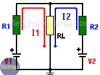
The Superposition Theorem
The Superposition theorem states that the effect of two or more voltage sources in a resistor is equal to the sum of the individual effects of each source taken separately, replacing all the remaining voltage sources with short circuits.