
Nonlinear Amplitude Control of a Sinusoidal Oscillator
In any practical oscillator, the loop gain (ßA) must be slightly greater than unity to prevent that the tolerance parameters of components, aging, temperature effects, etc., make that ßA < 1 and the circuit not meet one of the oscillation conditions specified in the equation:
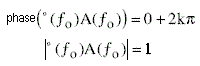
In which case the circuit will be oscillating.
On the other hand, if ßA > 1 the amplitudes of oscillation grows in amplitude and give rise to sinusoidal output signals with strong harmonic distortion (THD high). Therefore, a mechanism is needed to adjust the value to ßA = 1 based on a nonlinear gain control circuit of the amplifier. This circuit makes ßA >~1 for values of low output amplitude until it reaches a certain output value, in which case ßA = 1.
A typical example of a circuit of nonlinear gain, also known as limiter circuit, is presented in picture 2.a. It use two diodes D1 and D2 that, according to their conducting state, changes the amplifier gain as shown in picture 2.b. For low output voltages, both diodes are off, and the amplifier gain is -Rf/R1.
In this case, applying the principle of superposition, the voltages VA and VB can be expressed in terms of ± VCC and Vo as
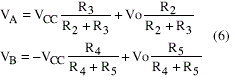
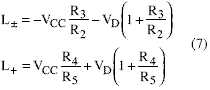
The diode D1 is ON when VA = -VD = -0.7 V and the diode D2 is ON when VB = VD = 0.7 V, in which case the amplifier gain decreases to – (Rf||R3)/R1 and – (Rf||R4)/R1 respectively.
The output voltages that make these diodes go into conduction are given by the following formulas:
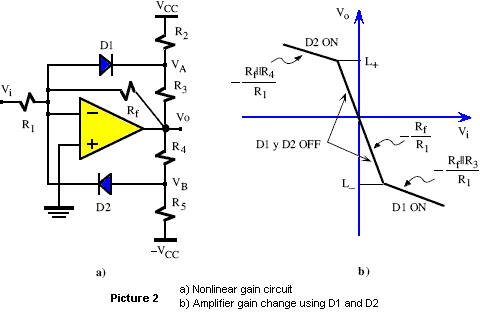 Nonlinear gain circuit – Amplifier gain change using D1 and D2
You may be interested in:
- Sinusoidal oscillator (basic structure)
- Sinusoidal oscillators – Basic principles
- UJT Relaxation oscillator circuit
- Crystal Oscillators – Piezoelectric Oscillator. Equivalente circuit
- LC Oscillator – Inductance – Capacitance Oscillator
- Phase Shift Oscillator
- Wien-bridge Oscillator with Op Amp
- Nonlinear Amplitude Control of a Sinusoidal Oscillator


